
The Income Tax department has enabled online filing for ITR-1 (Sahaj) and ITR-4 (Sugam) for the Assessment Year 2026-27, allowing small and medium taxpayers to file returns for income earned in the 2025-26 fiscal year.

Jio Platforms has announced the appointment of Akash Ambani as its managing director for a five-year term, effective from April 9, 2026, as the digital services company prepares for its highly anticipated Initial Public Offering.

India's fiscal deficit is projected to reach 4.5 per cent of GDP for the current fiscal year, exceeding the budgeted target, as the government's policy responses to the West Asia conflict are expected to strain public finances, according to research firm BMI.

The idea of back-loading the target of fiscal consolidation is perhaps guided by the government's desire to be prepared for any adverse developments in the coming year, points out A K Bhattacharya.

The Indian central government has reduced its total expenditure by approximately 60,000 crore in FY26, below its revised estimate, to successfully achieve the fiscal deficit target of 4.4 per cent of gross domestic product (GDP), according to the latest data from the Controller General of Accounts (CGA).

S&P Global Ratings projects India's economic growth to slow to 6.6 per cent in FY27, down from 7.7 per cent in FY26, citing energy stress and a potential sub-par monsoon.

Finance Minister Nirmala Sitharaman announced a fiscal deficit target of 4.3% of GDP for FY27, continuing the path of fiscal consolidation. The government aims to reduce the debt-to-GDP ratio to 55.6% by BE 2026-27 and further to around 50% by March 2031.

Force Motors Limited announced its highest-ever revenue and profitability for the fiscal year ending March 31, 2026, driven by growth across its Urbania, Trax, and Traveller platforms, as well as defence partnerships and international engine manufacturing.

The Reserve Bank of India (RBI) is anticipated to make its highest-ever dividend payment to the government this year, providing a significant fiscal boost to address challenges, including those stemming from the ongoing Middle East crisis.

Elevated global crude oil and natural gas prices, driven by geopolitical developments in West Asia, could significantly influence the Government of India's fiscal position for 2026-27, according to a report by ratings agency Icra.

A new white paper released by the Tamilaga Vettri Kazhagam (TVK) government reveals that Tamil Nadu's direct debt has nearly doubled to an alarming 10 trillion in the past five years, exposing significant fiscal strain and a substantial debt burden on every citizen.

IndiGo, India's largest airline, reported a net loss of Rs 2,536.9 crore in the March quarter of fiscal year 2025-26, primarily attributed to a significant foreign exchange loss of approximately Rs 8,100 crore, the impact of December flight disruptions, and expenses related to new labour laws.

The World Bank has increased India's economic growth projection for FY27 to 6.6 per cent, citing resilient domestic demand, while simultaneously cutting its global economic growth outlook due to the conflict in West Asia.

Pakistan has increased its defence budget by 17.6 per cent to PKRs 3,000 billion for the upcoming fiscal year, as announced by Finance Minister Muhammad Aurangzeb. The federal budget, estimated at PKRs 18,771 billion, targets 4 per cent GDP growth, with significant allocations for debt service and pensions. Prime Minister Shehbaz Sharif highlighted economic stability and ongoing discussions with the IMF, while the opposition protested Imran Khan's incarceration during the budget session.

India's exports reached a six-month high, growing by 18 per cent to USD 45.2 billion in May, driven by electronic goods, petroleum products, engineering items, and pharmaceuticals. However, the trade deficit widened to USD 28.21 billion due to a 10 per cent rise in imports, particularly petroleum products and gold, amidst surging crude oil prices.
India's economy registered a robust 7.7 per cent growth in the fiscal year 2025-26, an increase from 7.1 per cent in the previous year, with the January-March quarter alone seeing a 7.8 per cent expansion.

Life Insurance Corporation of India (LIC) announced a significant 23 per cent increase in its net profit for the March quarter, reaching Rs 23,420 crore, alongside a rise in total income and premium collections.
S&P Global Ratings has increased India's GDP growth forecast for the next fiscal year to 7.1 per cent, citing private consumption, investment, and exports as key drivers. However, the agency also cautioned that the conflict in the Middle East could strain India's fiscal position due to higher energy prices.

The Indian government has ratified an 8.25 per cent interest rate on Employees' Provident Fund (EPF) deposits for the financial year 2025-26, with over seven crore contributing members expected to see this credited to their accounts this month.

Indian carmakers experienced a robust start to the new fiscal year, with an estimated 4.5 lakh passenger vehicles sold in April, marking a 27 per cent increase year-on-year, attributed to factors like GST 2.0, repo rate cuts, and income tax benefits.

Indian benchmark indices Sensex and Nifty closed marginally lower due to profit-taking, following the Reserve Bank of India's decision to keep the repo rate unchanged while lowering its growth expectations for the current fiscal year and forecasting higher inflation.

Hybrid mutual fund schemes attracted significant inflows of Rs 1.55 lakh crore in FY26, a 29 per cent increase, as investors increasingly opted for diversified investment strategies to navigate volatile market conditions and geopolitical tensions.

A US federal judge has ruled that the USD 100,000 fee imposed by former President Donald Trump for H-1B visa applications was unlawful, as it lacked congressional approval. The ruling states the fee was a tax, exceeding the administration's authority and impacting skilled global talent.

The Indian government has marginally exceeded its indirect tax collection target for fiscal year 2025-26, with strong performances in customs, excise, and GST revenues.

S&P Global Ratings projects India's economy to grow at 6.3 per cent even if crude oil prices average USD 130 per barrel in the current fiscal year, highlighting the nation's resilience amidst the West Asia crisis and strong commitment to fiscal consolidation.

Here are the key numbers to watch out for in the Union Budget for 2025-26:

India's Central government is likely to see its fertiliser subsidy bill double to a record 3.4 trillion in FY27, up from the Budget estimate of 1.7 trillion, due to surging global fertiliser prices exacerbated by the West Asia war. This significant increase, coupled with revenue losses from excise duty cuts for oil-marketing companies, is straining the government's fiscal space, though capital expenditure plans remain unchanged.

Air India has temporarily reduced its domestic flights by 22 per cent due to the impact of high fuel prices, following a previous reduction in international flights. The airline is offering re-accommodation, date changes, or refunds to affected passengers.

Amid the arithmetic of subsidies, consumption and capacity, whichever government assumes office in Tamil Nadu after May 4 is likely to inherit a growing debate over how far the state can continue to expand welfare promises without placing additional strain on public finances and the power sector.

Leading stock exchange BSE Ltd announced a 61 per cent increase in consolidated net profit to Rs 795.47 crore for the March quarter, driven by higher income, and reported its highest-ever performance in its 150-year history for the full financial year 2025-26.

Mahindra & Mahindra Ltd reported a significant 48.5 per cent jump in consolidated profit after tax to Rs 5,259.91 crore in the March quarter, primarily attributed to strong performance in its auto and farm sectors, alongside ambitious plans for new SUV and EV launches.

Indian states significantly increased their reliance on market borrowings to finance gross fiscal deficits in 2025-26, with the share of market borrowings rising to 76.3 per cent, even as the weighted average cut-off yield on State Government Securities (SGS) and spreads over central government securities also increased.

India's net direct tax collections increased by 5.12 per cent to over Rs 23.40 lakh crore in the 2025-26 fiscal year, but this figure still fell short of the revised budget target of Rs 24.21 lakh crore, primarily due to income tax cuts implemented earlier in the year.
The OECD projects India's GDP to grow at 7.6% in the current fiscal year and 6.1% in 2026-27, despite global economic challenges stemming from the Middle East conflict and energy price volatility.
Bharti Airtel reported a 33.5 per cent decline in consolidated net profit to Rs 7,325 crore for the March 2026 quarter, primarily attributed to one-time provisions for statutory and tax liabilities.

The remarkable rise of smallcaps reflects the emergence of a broad set of specialised businesses operating in industries where the sectoral tailwinds remain considerably stronger than macroeconomic headwinds, points out Debashis Basu.
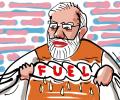
Following through announcements with enforcement of measures is key, as a run through recent Indian economic history shows, points out A K Bhattacharya.


Prime Minister Narendra Modi announced that the India-UK Comprehensive Economic and Trade Agreement (CETA) will come into effect on July 15, 2026, anticipating a significant boost to bilateral trade and investment.

Loss-making Air India has introduced a new 'Basic Fare' category for select domestic flights, which does not include complimentary meals, as part of its efforts to trim expenses amid rising operational costs.
